Multi-Agent Enterprise Architecture
Coordinating specialized AI agents under a central orchestrator to automate complex business workflows — with governance, memory, and human oversight built in from day one.
By Jai Ganesh
What is multi-agent enterprise architecture?
Multi-agent enterprise architecture coordinates a team of specialized AI agents — each owning a narrow role like document analysis, policy validation, or workflow execution — through an orchestration layer that assigns tasks, shares context, and determines execution paths. It is the pattern for automating workflows too complex for a single agent, while governance, observability, and human approval remain centralized. Specialization keeps each agent accurate; orchestration keeps the team coherent.
The Problem
A single agent hits a ceiling fast in the enterprise. Complex workflows — onboarding an employee, resolving a customer claim, processing an invoice exception — span multiple systems, multiple policies, and multiple kinds of expertise. Stuffing all of that into one agent produces a bloated context window, incoherent reasoning over long chains, and a prompt nobody can safely change.
The naive alternative — one agent per task, each built ad hoc — fragments just as badly: duplicated integrations, inconsistent guardrails, no shared knowledge, and no single place to answer the questions enterprises always ask: who approved this action, what data did it touch, and can we audit it?
The multi-agent pattern solves both failure modes: specialists stay small and testable, while the orchestration layer owns routing, shared context, and governance.
The timing matters, too. Orchestration frameworks have matured to the point where the hard problems are no longer "can agents collaborate" but "can we govern, observe, and afford it at enterprise scale." That shifts the architecture question from model capability to system design — which is exactly where most multi-agent initiatives succeed or stall.
The Architecture
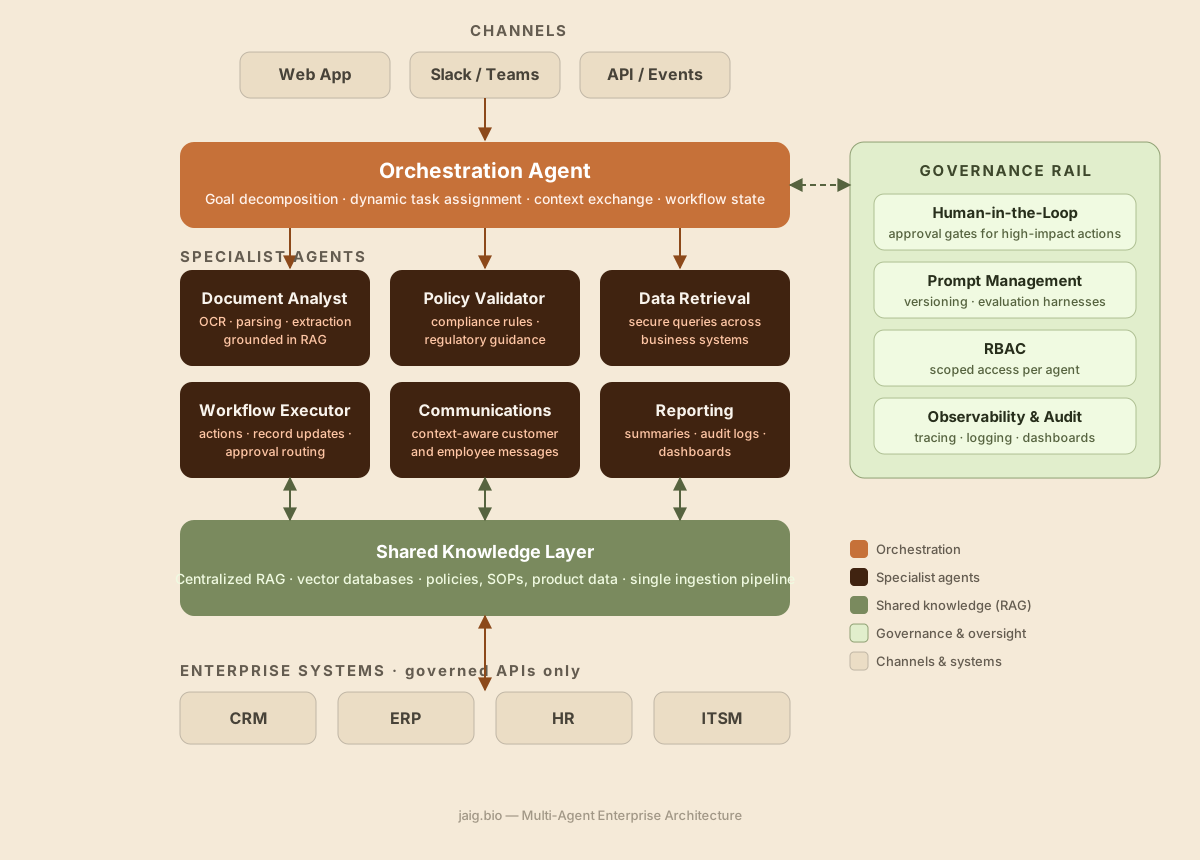
How It Works
Orchestration Agent
The entry point for every workflow. It decomposes the incoming goal into a task graph, dynamically assigns tasks to specialist agents, exchanges context between them, and determines the optimal execution path. It owns workflow state — no specialist agent talks directly to another.
Execution shapes
Decomposition follows three execution shapes, chosen per workflow rather than hardcoded. Sequential chains suit processes with strict ordering — extract, then validate, then post. Parallel fan-out suits independent subtasks — checking three policy domains simultaneously and merging results. Hierarchical delegation suits open-ended goals — the orchestrator assigns a sub-goal to a lead specialist, which briefs its own helpers and returns a consolidated result. Most real workflows mix all three, and the orchestrator's job is picking the cheapest shape that satisfies the workflow's ordering and approval constraints.
Specialist agents
Narrow, testable workers: a Document Analyst that parses unstructured documents with OCR and RAG; a Policy Validator that checks every output against enterprise rules and regulatory guidance; a Data Retrieval agent that queries CRM, ERP, HR, and ITSM systems through secure APIs; a Workflow Executor that triggers downstream actions and routes approvals; a Communications agent that drafts context-aware messages; and a Reporting agent that generates summaries and audit logs.
Context exchange & handoffs
The highest-leverage design surface in the whole pattern. Agents hand off through structured task briefs — goal, inputs, constraints, and expected output schema — not by sharing full conversation transcripts. Transcript-sharing feels collaborative but scales terribly: every agent pays tokens for every other agent’s reasoning, errors propagate as context, and the effective window shrinks with each hop. A brief is small, auditable, and testable — you can unit-test a specialist against a library of briefs the way you test an API against requests. The orchestrator composes each brief from workflow state, which means what an agent sees is a deliberate decision, not an accident of conversation history.
Shared knowledge layer
A centralized RAG layer over vector databases gives every agent the same grounded view of company knowledge — policies, SOPs, product data. Centralizing it prevents the per-agent knowledge drift that makes multi-agent answers contradict each other. It also enables workflow-level memory: what the Document Analyst extracted becomes retrievable context for the Policy Validator without re-parsing, and completed workflows leave structured traces that future runs retrieve as precedent. The knowledge layer is not just a document store — it is where the platform’s experience accumulates.
Failure containment & recovery
Multi-agent systems fail in ways single agents cannot: a specialist times out mid-workflow, returns malformed output, or confidently completes the wrong subtask. The platform treats each agent call like an unreliable network call — schema validation on every response, retries with the same idempotent task semantics as any distributed system, and per-agent circuit breakers so one degraded specialist degrades one capability instead of the whole platform. When retry and fallback are exhausted, the workflow parks in a human queue with full state — the failure mode is always “a person picks it up,” never “the work disappears.”
Governance rail
Cross-cutting services that every agent action flows through: human-in-the-loop approval gates for high-impact decisions, prompt management with versioning, RBAC scoping what each agent may touch, and observability dashboards with full audit logging.
Enterprise system integrations
Agents reach business systems through governed API connections — never direct database access. Each integration is scoped to the specific agent that needs it, keeping the blast radius of any single agent small.
Design Decisions
Hub-and-spoke orchestration over peer-to-peer agent chatter
Free-form agent-to-agent conversation is impossible to audit and debug. Routing everything through the orchestrator gives one place to log decisions, enforce policy, and reconstruct any workflow after the fact — the properties enterprise compliance actually requires.
Centralized RAG layer instead of per-agent knowledge stores
When each agent embeds its own documents, answers drift apart and updates require touching every agent. One shared, versioned knowledge layer means one ingestion pipeline, one source of truth, and consistent grounding across the whole platform.
Human-in-the-loop as an architectural gate, not an afterthought
Approval checkpoints are wired into the orchestration layer for actions above defined impact thresholds — financial commitments, external communications, records changes. Autonomy is bounded by design; trust is earned by widening the thresholds over time, not by starting wide.
A dedicated Policy Validator agent rather than inline checks
Separating validation from generation means guardrails evolve independently of the agents they police, and every output crosses the same compliance bar regardless of which specialist produced it.
Production plumbing from day one
Prompt versioning, evaluation harnesses, observability, and audit logging are part of the platform, not a hardening phase. Retrofitting observability onto a live agent system is far more expensive than building on it.
Structured task briefs over shared transcripts
Passing full conversation history between agents is the default in most frameworks and the first thing to remove in production. Briefs cut token cost per hop, stop one agent’s hallucination from becoming another agent’s ground truth, and make every handoff a typed, loggable contract. If you cannot say precisely what context an agent received, you cannot debug what it did.
Evaluate the workflow, not just the agents
Per-agent evals catch a specialist regressing; they miss the failure that matters most — individually correct steps composing into a wrong outcome. Workflow-level golden sets (input → expected end state, with expected approval stops) run on every prompt or model change. The unit of trust the business cares about is the workflow, so that is the unit the evaluation harness scores.
Trade-offs & Limits
- ›Latency: orchestrated workflows make multiple model calls per task. Fine for back-office automation measured in minutes; wrong for sub-second interactive experiences.
- ›Cost: more agents means more inference. The pattern pays for itself on high-value workflows, not on tasks a single well-prompted call could handle.
- ›Operational complexity: you are running a distributed system. Without the observability rail this architecture is harder to debug than what it replaces — the governance components are not optional.
- ›Orchestrator as a single point of failure: it needs the same reliability engineering (retries, state persistence, idempotent task dispatch) as any critical workflow engine.
- ›Error compounding: a 95%-accurate step chained five deep is a 77%-accurate workflow. Validation gates between steps are what keep composed accuracy acceptable — and they are also why per-step cost is higher than the naive sum of model calls.
When To Use It
- ✓Workflows spanning multiple business systems and domains of expertise
- ✓Processes with compliance, audit, or approval requirements
- ✓Automation where per-step traceability matters more than raw speed
- ✓Platforms expected to grow — new capability arrives as a new specialist agent, not a rewrite
- ✓Organizations that need per-capability ownership — different teams own different specialists, deployed on independent lifecycles
When Not To
- ✕Single-domain tasks a single agent with good tools handles cleanly
- ✕Latency-critical, user-facing interactions
- ✕Early prototypes — prove value with one agent before scaling to a team of them
Enterprise architect and independent AI consultant — I help teams take agentic systems from deck to production, with the governance story intact.