Enterprise AI Governance & Cost Architecture
Running many AI use cases without losing control of risk or spend — one gateway all traffic flows through, a registry of approved models and prompts, risk-tiered policy, and cost treated as architecture instead of an invoice surprise.
By Jai Ganesh
What is enterprise AI governance and cost architecture?
Enterprise AI governance and cost architecture is the platform layer that lets an organization run many AI use cases without losing control of risk or spend: a central gateway all AI traffic flows through, a registry of approved models and prompts with versioning, policy enforcement and audit at the platform level, and cost controls — semantic caching, model right-sizing, budgets, and per-use-case attribution — treated as architecture rather than as an invoice surprise. Governance done this way is an enabler: teams ship AI faster because the guardrails and the meter are already built.
The Problem
AI adoption inside an enterprise follows a predictable arc: one team’s pilot becomes five teams’ tools becomes forty use cases nobody can enumerate — each with its own API keys, its own prompts in its own repo, its own idea of acceptable use, and its own line on an invoice nobody reconciles. The organization is suddenly running a distributed AI estate with no map of it.
Then come the two reckonings. Compliance asks which use cases touch customer data, which models process it, and where — and the answer is a spreadsheet-hunting exercise across teams. Finance asks why model spend tripled — and nobody can say which use case did it, whether the spend bought anything, or which calls a cheaper model could have served identically.
The failure is architectural, not organizational: there was never a layer where AI usage could be seen, governed, and metered as a whole. The common answer — a review board and a policy document — governs slowly and measures nothing. A platform layer does both in real time, and does something the review board cannot: it makes the governed path the easiest path to ship on.
The Architecture
How It Works
The AI gateway
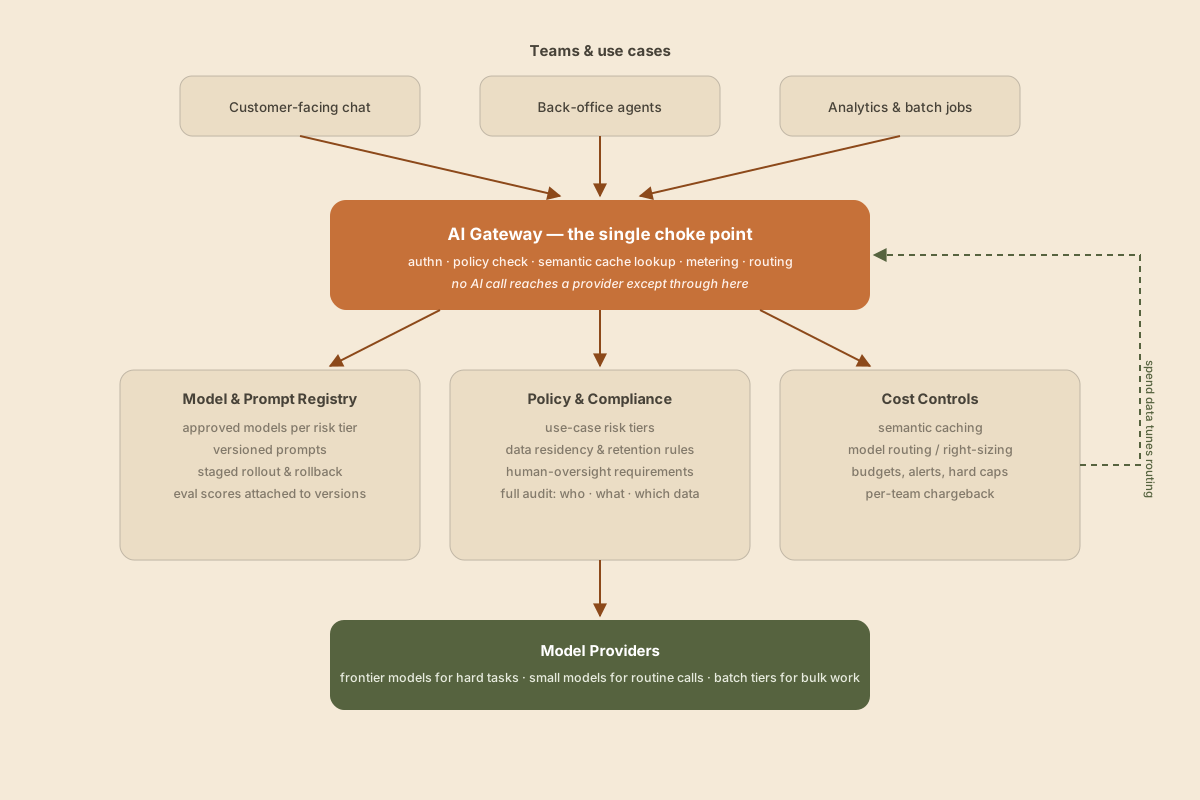
One choke point every AI call flows through — no team holds provider keys directly. Each request is authenticated to a team and use case, checked against policy, looked up in the semantic cache, metered, and routed to an approved model. The gateway is what converts governance from an audit exercise into a runtime property: unapproved usage is not forbidden, it is impossible.
Model and prompt registry
The catalog of what is approved to run: models vetted per risk tier and data classification, prompts versioned with staged rollout and one-step rollback, and evaluation scores attached to every version. “Which prompt was live when that answer shipped?” becomes a lookup — the provenance question that ad hoc prompt management cannot answer.
Policy and compliance layer
Use cases are classified into risk tiers, and tiers carry requirements: which models and regions are allowed, what data may flow, whether human oversight is mandatory, how long records are retained. The gateway enforces these per call, so classification once means compliance continuously — and a low-risk internal tool is not paying the process tax of a customer-facing one.
Cost attribution and budgets
Every metered call carries team, use case, model, and token counts, rolling up into real-time attribution — cost per use case, per team, per answer. Budgets carry alerts and, where appropriate, hard caps. The invoice stops being a surprise because it stops being the first place spend becomes visible.
Cost optimization pipeline
The levers, in order of harm done when misapplied: semantic caching first — the cheapest call is the one not made, and repeated questions are a large share of real traffic. Then model right-sizing, routing routine calls to small models and reserving frontier models for tasks where quality measurably pays. Then batch tiers for anything that does not need an answer in seconds. Each lever is validated against the evaluation harness, because savings that degrade quality are a cost.
Audit and reporting
The platform answers the enterprise questions as queries, not projects: who ran what, with which model and prompt version, touching which data classification, at what cost, with what quality scores. Compliance reporting, incident forensics, and the quarterly spend review all read from the same trace the gateway was already writing.
Design Decisions
One gateway, not per-team plumbing
Forty teams calling providers directly means forty places to enforce policy and zero places to see the whole. A single gateway makes visibility and enforcement structural — and pays teams for the routing hop with caching, retries, failover, and metering they no longer build themselves.
Risk-tiered governance, not one-size-fits-all review
Governing an internal doc-summarizer like a customer-facing financial advisor guarantees the review board becomes the bottleneck everyone routes around. Tiers put the scrutiny where the risk is — and give low-risk experiments a fast lane, which is what makes the governed path the attractive one.
Route by task difficulty, not by team preference
Most enterprise AI calls are routine — classification, extraction, reformatting — and small models handle them at a fraction of frontier cost. Defaulting every call to the biggest model is the single most common source of runaway spend. Routing policy, validated by evals, decides where quality actually buys something.
Caching before any model downgrade
Semantic caching is the one cost lever with no quality tradeoff — the answer served is an answer already validated. Exhausting it before touching model selection means the harder levers start from a smaller bill.
Chargeback visibility from day one
Teams that see their own metered spend tune their own usage — prompt lengths shrink, batch jobs move off realtime tiers, caches get warmed — without a policy memo ever being written. Attribution changes behavior faster than restriction does, and with less resentment.
Trade-offs & Limits
- ›The gateway is a critical dependency: it needs platform-grade reliability, latency budgets, and a degradation story, because when it is down, every AI feature in the company is down.
- ›Miscalibrated tiers recreate the bottleneck the platform was meant to remove — tier definitions need an owner and a review cadence, or everything drifts into the high-scrutiny lane.
- ›Aggressive semantic caching risks stale or subtly mismatched answers; cache keys, TTLs, and similarity thresholds are quality decisions, not just cost ones.
- ›Cost routing adds a decision layer that itself needs evaluation — a misrouted task class silently trades answer quality for savings until the harness catches it.
When To Use It
- ✓More than a handful of AI use cases, or more than one team shipping them
- ✓Regulated environments where model, data, and region constraints must be provable per call
- ✓Organizations whose AI spend has crossed from rounding error to line item
- ✓Platform teams asked to make AI adoption faster and safer at the same time — this is the layer that does both
When Not To
- ✕One team, one use case — a gateway for a single caller is ceremony; adopt the patterns, not the platform
- ✕Pure experimentation phases where constraining model choice would strangle the learning
- ✕As a paper exercise: a governance layer that observes but cannot enforce converges on the spreadsheet it replaced
Enterprise architect and independent AI consultant — I help teams take agentic systems from deck to production, with the governance story intact.