Production Agentic AI Architecture
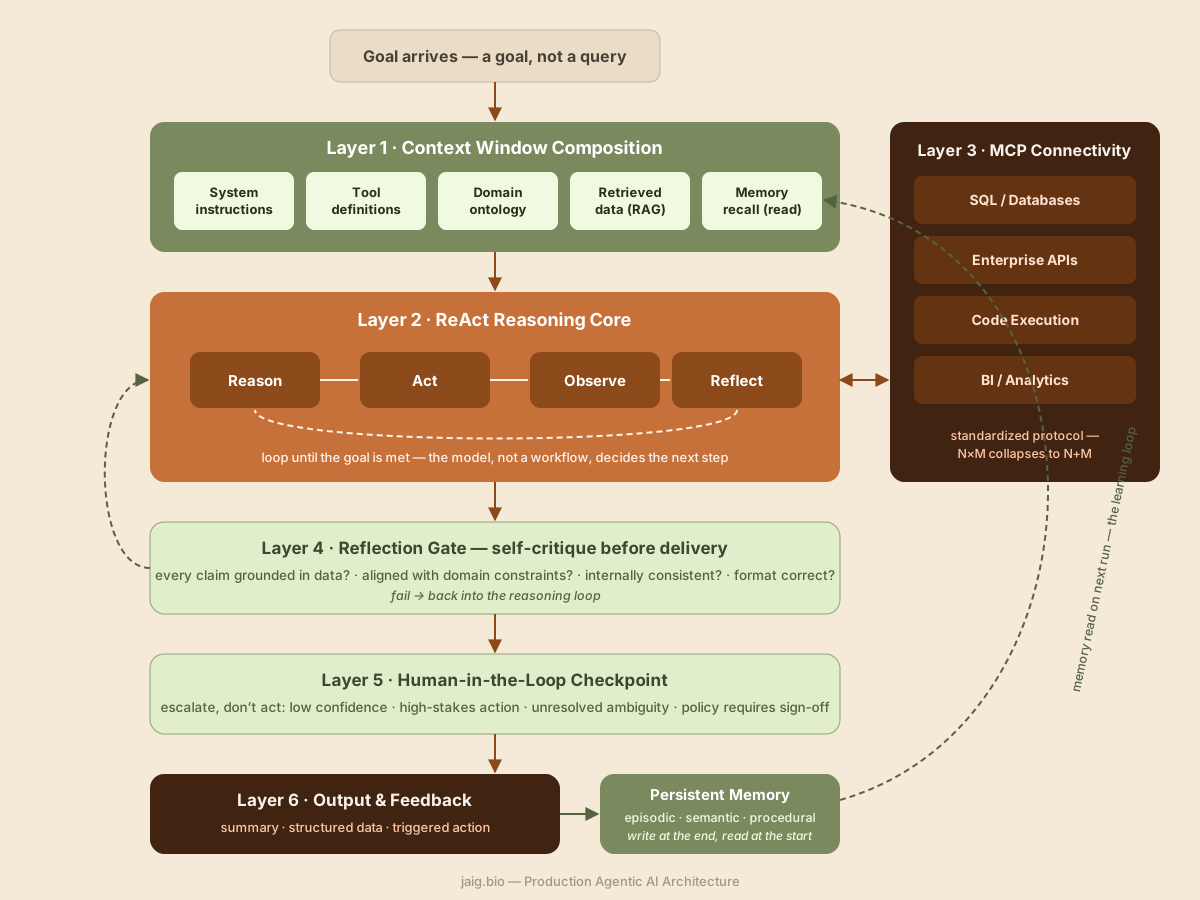
The six-layer anatomy of a single production agent — context engineering, a ReAct core, standardized tool connectivity, a self-critique gate, bounded human oversight, and a memory read/write cycle that compounds capability over time.
By Jai Ganesh
What is production agentic AI architecture?
Production agentic AI architecture is the design of an AI agent that can be trusted with real work: six layers covering context assembly, a ReAct reasoning loop, standardized tool connectivity (MCP), a self-critique gate, human-in-the-loop checkpoints, and persistent memory. Unlike a chatbot, a production agent plans multi-step work, uses tools, validates its own output, and escalates to humans at defined confidence and impact thresholds. The architecture exists to make agent behavior predictable, auditable, and durable enough for business-critical workflows.
The Problem
Most agent demos are a prompt, a tool loop, and optimism. They work until the first ambiguous goal, the first hallucinated claim delivered as fact, the first 30-second inference call that fails mid-task and loses the user's work. The gap between a demo agent and a production agent is not model quality — it is architecture.
A production agent has to answer questions a demo never faces: what exactly went into the context window for this decision? What stops an ungrounded claim from reaching a user? When does the agent act on its own, and when must it escalate to a human? And how does anything it learns survive to the next session?
This pattern assembles the answers into six explicit layers wrapped around a persistent memory system — each layer a checkpoint you can test, monitor, and tighten independently.
The Architecture
How It Works
Layer 1 — Context window composition
When a goal arrives, the context is assembled fresh from five components: system instructions (role, behavioral rules, output format), tool definitions, domain ontology (KPI definitions, business rules, thresholds), retrieved data from RAG, and memory recall. Memory is read here — relevant episodes, facts, and procedures are pulled in before reasoning begins. Context design, including what to leave out, is the primary determinant of agent quality.
Layer 2 — The ReAct reasoning core
A persistent Reason → Act → Observe → Reflect cycle that repeats until the goal is achieved. The model, not a pre-defined workflow, determines the next step at every iteration — that is what makes it an agent rather than a pipeline.
Layer 3 — MCP tool connectivity
SQL, enterprise APIs, code execution, and BI systems are all reached through the Model Context Protocol rather than bespoke integrations. Onboarding a new tool is a registry entry and an IAM grant, not a redeployment — the N×M integration problem collapses to N+M.
Layer 4 — The reflection gate
Before anything is delivered, the agent validates its own output: Is every claim grounded in data? Does it align with domain constraints? Are there internal contradictions? Is the format correct? A failure sends the agent back into the reasoning loop instead of forward to the user.
Layer 5 — Human-in-the-loop checkpoint
The agent escalates rather than acts when confidence is low, the action is high-stakes, ambiguity cannot be resolved, or policy requires sign-off. Autonomy is bounded by design, not by accident.
Layer 6 — Output and feedback, closing the memory loop
The agent delivers a summary, structured data, or a triggered action — and captures corrections, new facts, and successful tool sequences, which are written back to three memory tiers: episodic (what happened), semantic (what we know), and procedural (how we do things). Memory read at the start, written at the end: that read/write cycle is the learning loop that makes the agent smarter over time.
Design Decisions
Context assembled per step, not accumulated per session
Letting conversation history pile up until the window overflows is how agents lose coherence. Composing the context fresh at each step — with explicit budgets for instructions, tools, retrieved data, and memory — keeps reasoning sharp on long-running tasks and makes context content auditable.
MCP over bespoke tool integrations
Every custom model-to-tool connection is brittle and unauditable at scale. A standardized protocol makes tools discoverable, swappable, and governable — and makes adding a capability an operational task instead of a development cycle.
A reflection gate separate from the reasoning loop
Self-critique inside the loop gets skipped under pressure to finish. Making validation a distinct architectural layer guarantees every output crosses the same bar — grounding, constraints, consistency, format — before it can reach a user or trigger an action.
Escalation thresholds as configuration, not prompt language
Burying "ask a human when unsure" in the prompt produces unpredictable compliance. Explicit confidence and impact thresholds wired into the checkpoint layer make the autonomy boundary testable — and let you widen it deliberately as trust accumulates.
Three-tier memory instead of a single conversation log
A raw transcript is not memory. Episodic, semantic, and procedural tiers serve different retrieval patterns — similarity-matched episodes as few-shot examples, facts injected as grounding, procedures living in the system prompt itself — and they feed each other: events consolidate into facts, facts inform skills.
Durable task dispatch around the inference call
Long inference calls fail. Idempotent task creation, persisted turn state, and retry semantics mean a transient failure costs a retry, not the user's work — the difference between an agent people trust and one they screenshot.
Trade-offs & Limits
- ›Latency: per-step context assembly, reflection passes, and memory reads add model calls. This is an architecture for delegated work, not instant chat.
- ›Cost: reflection and memory operations multiply token spend. Budget for it — or scope the pattern to workflows where correctness is worth more than tokens.
- ›Memory quality is a discipline: unpruned episodic memory becomes noise, and stale semantic facts are worse than no facts. Memory needs curation, decay, and evaluation like any data system.
- ›Procedural memory is the least-solved tier: consolidating successful runs into evolving prompts is still largely custom engineering rather than an off-the-shelf capability.
When To Use It
- ✓Delegated, multi-step work where the agent must plan, use tools, and verify its own output
- ✓Domains where ungrounded claims or unauthorized actions carry real cost
- ✓Long-lived assistants expected to improve from their own history
- ✓Tasks spanning 30+ second tool or inference calls that need durability guarantees
When Not To
- ✕Single-turn Q&A or content generation — a well-prompted model call is cheaper and faster
- ✕Hard real-time paths where reflection and memory latency are unacceptable
- ✕Throwaway prototypes — prove the use case before building six layers around it
Enterprise architect and independent AI consultant — I help teams take agentic systems from deck to production, with the governance story intact.
Seen In Practice
- What We Learned Building a Durable AI Agent Pipeline on GCP →
- The Four Architecture Patterns of Agentic AI — Anatomy of a Production Agent →
- Multi-Agent Business Process Automation Platform — case study →
- Multi-Agent Enterprise Architecture — when one agent becomes a team →
- Agent Evaluation Architecture — how the evals layer earns its keep →
- When Your Agent Runs Out of Tools — what happens past the tool registry’s edge →