Human-in-the-Loop Agent Architecture
Bounding agent autonomy by design — a policy gate that decides when the agent acts alone and when a human approves, with every decision feeding a trust dial that widens autonomy on evidence, not optimism.
By Jai Ganesh
What is human-in-the-loop agent architecture?
Human-in-the-loop (HITL) agent architecture bounds AI autonomy by design: a policy gate classifies every proposed action by confidence, impact, and reversibility, then either auto-executes it or routes it to a human approval queue. Approval decisions — including modify-and-approve — feed a trust dial that widens autonomy based on evidence, not optimism. It's how organizations get the productivity of autonomous agents while keeping high-stakes decisions governed and auditable.
The Problem
The two default postures for agent autonomy are both wrong. Full autonomy means the first bad refund, wrong customer email, or mistaken record change becomes an incident review — and usually the end of the program. A human approving everything means you have built an expensive suggestion box, and the approvers stop reading before week two.
The question is not whether humans stay in the loop; it is where the loop sits, what the human actually sees when asked to decide, and how the boundary moves over time. Most implementations fail on the second point: an approval request that just says "approve this action?" without evidence gets rubber-stamped, which is oversight theater, not oversight.
This pattern makes autonomy an explicit, tunable architectural boundary: a policy gate in code, an approval experience designed for real decisions in seconds, and a feedback loop that treats every human decision as labeled data.
The Architecture
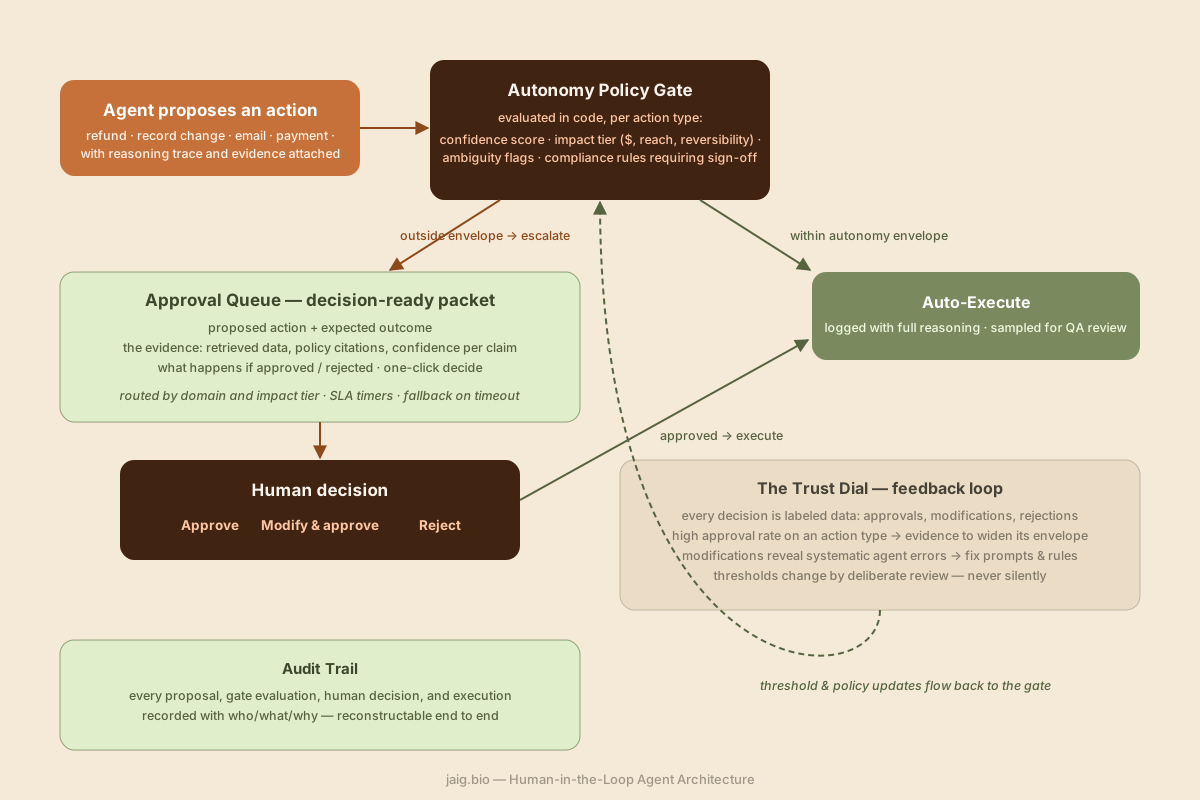
How It Works
Action proposals with evidence attached
The agent never executes directly from reasoning. It emits a structured proposal: the action, expected outcome, the evidence it relied on (retrieved data, policy citations), and its confidence. This separation is what makes gating, auditing, and learning possible.
The autonomy policy gate
Evaluated in code per action type: confidence score, impact tier (monetary value, external reach, reversibility), ambiguity flags, and compliance rules that mandate sign-off regardless of confidence. Within the envelope → auto-execute, logged and sampled for QA. Outside → escalate. The envelope is configuration, not prompt language.
The approval queue as a decision-ready packet
Escalations arrive as everything a human needs to decide in seconds: proposed action, expected outcome, the evidence with per-claim confidence, and what happens on approve versus reject. Routed by domain and impact tier, with SLA timers and safe fallbacks on timeout so workflows never hang on an unread request.
Three-way human decisions
Approve, modify-and-approve, or reject — and the modify option matters most. It keeps workflows moving when the agent was nearly right, and each modification pinpoints exactly what the agent got wrong, which rejection alone never reveals.
The trust dial
Every decision is labeled data. Sustained high approval rates on an action type are evidence for widening its envelope; clusters of modifications reveal systematic errors to fix in prompts and rules; thresholds change through deliberate review, never silently. Autonomy is earned per action type, not granted globally.
The audit trail
Every proposal, gate evaluation, human decision, and execution recorded with who, what, and why — the workflow is reconstructable end to end, which is the difference between an incident and an unanswerable question.
Design Decisions
Escalation thresholds in configuration, not in the prompt
"Ask a human when unsure" produces whatever compliance the model feels like today. Thresholds in code are testable, versioned, reviewable — and changing the autonomy boundary becomes a governed act instead of a prompt tweak.
Impact tiers based on reversibility, not just value
A $50 external email can be more dangerous than a $5,000 internal ledger entry that reverses in one click. Classifying actions by blast radius and undoability routes attention where mistakes actually cost.
Modify-and-approve as a first-class outcome
Binary approve/reject forces humans to reject near-misses, stalling workflows and hiding what was almost right. Modifications keep throughput and generate the most precise training signal the system gets.
Timeouts with safe fallbacks on every approval
An unread approval request must never hang a workflow indefinitely. Escalate up, expire into rejection, or park with notification — chosen per action type, but always defined.
Sampled QA review of auto-executed actions
The envelope is only trustworthy if you keep measuring inside it. Sampling autonomous actions for retrospective review catches drift before it compounds — trust is verified continuously, not assumed after week one.
Decision-ready packets over bare confirmation dialogs
The quality of oversight equals the quality of what the approver sees. Evidence, confidence, and consequences in one view produce real decisions; "Approve?" produces rubber stamps.
Trade-offs & Limits
- ›Approval latency becomes part of workflow latency — SLAs and routing need the same attention as any queue-based system.
- ›Reviewer fatigue is the failure mode: thresholds set too conservatively flood the queue and train humans to approve blindly, recreating the problem with extra steps.
- ›The approval UX is a real product surface with real users; underinvest and the whole governance layer degrades.
- ›Envelope governance needs an owner — someone accountable for reviewing the trust dial's evidence and deciding threshold changes.
When To Use It
- ✓Agents that touch money, customers, records, or anything external-facing
- ✓Regulated domains where sign-off is a compliance requirement, not a preference
- ✓New agent deployments — start conservative and widen the envelope on evidence
- ✓Any workflow where one bad autonomous action costs more than a thousand approvals
When Not To
- ✕Read-only or draft-only agents whose output a human already reviews by definition
- ✕Low-stakes internal tooling where the approval overhead exceeds the risk
- ✕Hard real-time paths that cannot absorb human latency — redesign the action to be reversible instead
Enterprise architect and independent AI consultant — I help teams take agentic systems from deck to production, with the governance story intact.