AI Guardrails & Security Architecture
Keeping LLM systems safe to expose to real users and real data — input defenses, permission boundaries the model cannot cross, output validation, and least-privilege tool scoping, all built on one principle: the model is untrusted.
By Jai Ganesh
What is AI guardrails and security architecture?
AI guardrails and security architecture is the set of controls that keep an LLM system safe to expose to real users and real data: input defenses against prompt injection and jailbreaks, permission enforcement outside the model, output validation for grounding, PII, and policy, and least-privilege tool scoping so a compromised or confused agent has a small blast radius. The organizing principle is that the model is untrusted by design — every guarantee that matters is enforced in the architecture around it, never by asking the model to behave.
The Problem
The moment an LLM system touches real users and real data, it inherits a threat model no prompt can handle. Users will try to jailbreak it. Documents it retrieves will contain text crafted to hijack it — prompt injection hides in emails, PDFs, and web pages precisely because the model treats everything in its context as potentially instructive. And the model itself will sometimes simply be wrong in fluent, confident sentences.
The instinctive defense — writing “do not reveal confidential information” into the system prompt — is not a control. It is a request, made to a system whose defining property is that its behavior is shaped by whatever text it reads. Every serious incident pattern in LLM security starts with an architecture that trusted the model to police itself.
The pattern here inverts that: assume the model can be manipulated, and build the guarantees around it. Permissions enforced before content reaches the context window. Tools scoped so the worst manipulation has a small blast radius. Outputs validated by systems the model cannot talk its way past. The model stays creative; the architecture stays paranoid.
The Architecture
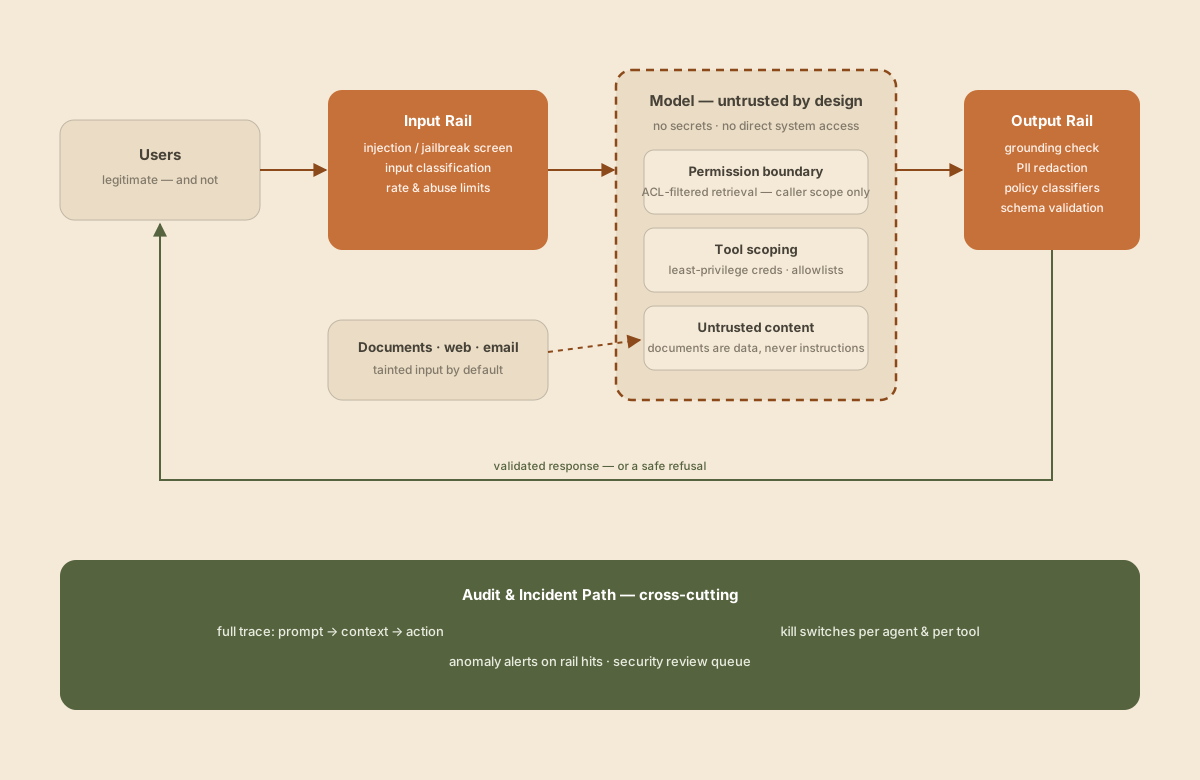
How It Works
Input rail
The first screen on everything a user sends: injection and jailbreak pattern detection, input classification to keep requests inside the system’s intended scope, and rate and abuse limits. It will not catch everything — the point is to cheaply remove the bulk of hostile traffic and tag the suspicious remainder for closer handling downstream.
Identity and permission boundary
The caller’s identity and entitlements are enforced at retrieval and at every tool call — before content enters the context window. The model never sees a document the caller could not open themselves, which means no injection, however clever, can exfiltrate what was never retrieved. Security lives where the data is fetched, not where the answer is worded.
Tool scoping and least privilege
Every tool an agent can invoke carries its own scoped credentials: the email tool can send but not read, the database tool touches one schema read-only, the ticketing tool acts as the calling user and no one else. Allowlists define what exists; per-tool credentials define what is possible. A manipulated agent can only misuse what its narrowest scope allows.
Untrusted-content handling
Retrieved documents, web results, and inbound email are data, never instructions. Structurally separating them from the instruction channel — delimited, labeled, and where possible processed by a model pass that has no tool access — is the core defense against indirect injection: the attack where a poisoned document tells the agent what to do next.
Output rail
Every response crosses the same bar before reaching a user or triggering an action: grounding checks against retrieved sources, PII detection and redaction, policy classifiers, and schema validation on anything that downstream systems will execute. The output rail is also where a bad answer becomes a safe refusal — the system’s last word is validated, or it is not spoken.
Audit and incident path
Every request carries a full trace — prompt, assembled context, retrieved sources, tool calls, and output — because “what did the model see when it did that?” is the first question in any AI incident. Rail hits feed anomaly alerts and a security review queue, and kill switches exist per agent and per tool, so containment is a configuration change rather than an emergency deploy.
Design Decisions
The model is untrusted — enforce outside it
Every guarantee that matters — who sees what, which actions fire, what leaves the system — is enforced by infrastructure the model cannot influence with words. Prompted safety is behavior; architectural safety is a property. Only one of them survives an adversary.
Layered rails over one perfect filter
No single classifier catches everything, and the ones that try are either porous or so aggressive they strangle legitimate use. Independent layers — input, permissions, tools, output — mean an attack must beat all of them, and each layer stays simple enough to test and tune on its own.
Deterministic checks before model-based checks
Regex, allowlists, schema validation, and permission lookups are fast, free, and cannot be sweet-talked. Model-based classifiers add judgment where determinism runs out — but running them second means the expensive, fallible layer only sees what the cheap, reliable one could not decide.
Treat retrieved content as tainted input
Indirect injection is the attack that scales: nobody needs access to your system, only to a document your system will someday read. Structural separation of content from instructions is the defense that does not depend on recognizing the attack — unrecognized hostile text in the data channel is still just data.
Fail closed on impact, fail open on inconvenience
When a rail is uncertain about an external email or a payment, the action blocks and escalates. When it is uncertain about an internal summary, the response ships with a log entry. Calibrating failure behavior to blast radius keeps the system both safe and usable — uniform strictness would sacrifice one for the other.
Trade-offs & Limits
- ›Rails add latency to every call — most of it parallelizable, none of it free. Budget for it per use case rather than discovering it in the p95.
- ›False positives are a real cost: legitimate users blocked by an over-eager classifier lose trust as fast as users who saw something leak. Thresholds need tuning against measured traffic, not set-and-forget defaults.
- ›Injection defense is an arms race. The rails shrink the attack surface and contain the blast radius; they do not end the contest, and the audit trail exists because something will eventually get through.
- ›Every layer is another component to test, monitor, and version — security architecture multiplies the surfaces the evaluation harness must cover.
When To Use It
- ✓Any LLM system exposed to users outside the building — or to content from outside the building
- ✓Agents holding tool access: email, payments, records, tickets — anything with a blast radius
- ✓RAG over documents with access restrictions, where a leak is a breach rather than an embarrassment
- ✓Regulated industries where “the model decided to” is not an acceptable incident report
When Not To
- ✕Internal prototypes on public data — start with permissions and audit, add rails as exposure grows
- ✕Fully human-reviewed output where the reviewer is the output rail
- ✕As a substitute for data governance: guardrails bound the model, not a broken permission model beneath it
Enterprise architect and independent AI consultant — I help teams take agentic systems from deck to production, with the governance story intact.