AI Document Processing Architecture
Turning invoices, POs, and receipts into validated, posted transactions — OCR plus schema-constrained LLM extraction, business-rule validation, a confidence router, and a human review queue whose corrections compound accuracy over time.
By Jai Ganesh
What is AI document processing architecture?
AI document processing architecture turns unstructured documents — invoices, purchase orders, receipts, contracts — into validated, structured transactions. It pairs OCR for positional grounding with schema-constrained LLM extraction, runs results through deterministic business-rule validation, and routes each document by confidence: high-confidence documents post straight through, low-confidence ones go to human review. Corrections feed back into the system, so accuracy compounds and review volume falls over time.
The Problem
Manual document entry is the quiet tax on every back office: someone re-keys invoices into the accounting system, chases mismatched totals, and files the paper. Template-based OCR tools promised to fix this and mostly didn't — every new vendor layout broke the template, and anything scanned crooked or photographed on a phone fell back to a human.
Pure-LLM extraction has the opposite failure: it reads anything, but happily invents a total, transposes an account number, or double-posts on a retry. In a financial pipeline, a 2% silent error rate is not automation — it is a liability with better throughput.
The production answer is a pipeline that pairs OCR's positional fidelity with the LLM's format flexibility, validates everything against business rules, and — critically — routes by confidence: full automation where the system is sure, fast human review where it is not.
The Architecture
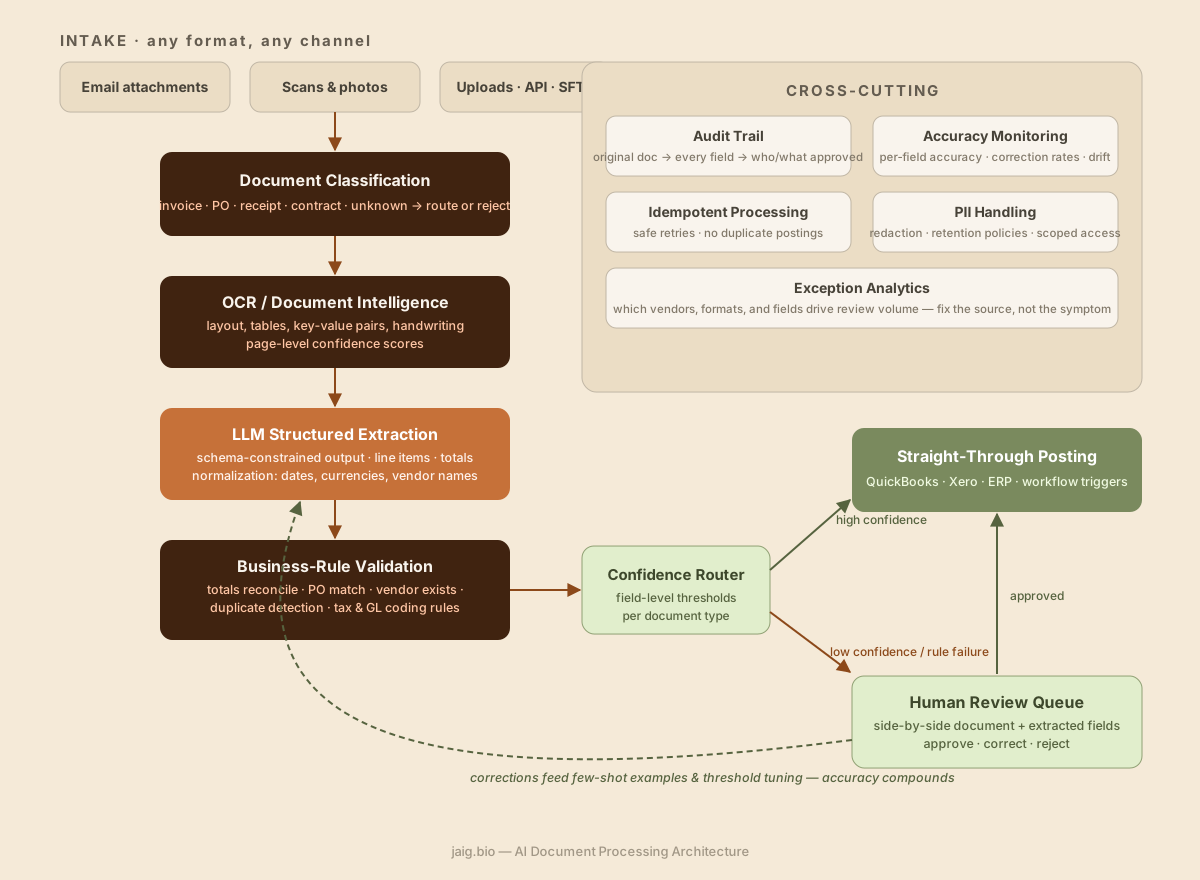
How It Works
Intake and classification
Documents arrive from anywhere — email attachments, scans, phone photos, uploads, SFTP. A classification step identifies the document type (invoice, PO, receipt, contract) and routes it to the right extraction schema; unknown types are rejected early with a clear reason instead of producing garbage downstream.
OCR / document intelligence
A document-intelligence service extracts layout, tables, key-value pairs, and handwriting with positional and confidence data per element. This layer anchors every extracted value to a physical location on the page — the foundation for auditability.
LLM structured extraction
The LLM maps messy OCR output into a strict, schema-constrained structure: header fields, line items, totals. It normalizes what OCR cannot — date formats, currency symbols, vendor name variants — and returns field-level values that downstream validation can check mechanically.
Business-rule validation
Deterministic checks run before anything is trusted: do line items sum to the total, does the PO exist and match, is the vendor known, is this a duplicate of a document already processed, do tax and GL-coding rules apply cleanly. Rules are code, not prompts — they cannot be talked out of a mismatch.
Confidence router
Field-level confidence thresholds, set per document type, split the flow: high-confidence documents post straight through to QuickBooks, Xero, or the ERP; anything below threshold — or failing a rule — lands in the review queue. The thresholds are the automation dial: start conservative, widen with evidence.
Human review queue and the feedback loop
Reviewers see the document and extracted fields side by side, and approve, correct, or reject in seconds rather than re-keying from scratch. Every correction is captured: it feeds few-shot examples for extraction, tunes thresholds, and surfaces exception analytics — which vendors, formats, and fields drive review volume — so the source gets fixed, not just the symptom.
Design Decisions
OCR + LLM as separate stages, not an end-to-end model
OCR provides positional grounding and per-element confidence; the LLM provides format tolerance and normalization. Fusing them loses the audit trail from extracted value back to a location on the page — the thing a controller asks for first.
Schema-constrained extraction over free-form output
Forcing the LLM into a strict output schema turns hallucination from a silent corruption into a visible validation failure. A missing field is recoverable; a plausible invented one is not.
Validation as deterministic code, never as a prompt
"Check that the totals add up" belongs in arithmetic, not in a model's judgment. Deterministic rules give binary, testable outcomes and an unambiguous reason for every rejection.
Confidence routing instead of all-or-nothing automation
The realistic goal is not 100% automation — it is 80–90% straight-through with trustworthy triage of the rest. Field-level thresholds per document type let each flow earn more autonomy as measured accuracy accumulates.
Idempotent, resumable processing
Documents arrive twice, networks fail mid-post, and retries happen. Idempotency keys derived from document identity make a double-posting architecturally impossible rather than operationally unlikely.
Corrections captured as training signal, not just fixes
A review queue that only fixes today's document plateaus. One that feeds corrections back as few-shot examples and threshold updates compounds — review volume falls month over month on the same intake mix.
Trade-offs & Limits
- ›Two-stage extraction costs more per document than a single call — justified by audit requirements and error economics, not by throughput alone.
- ›Confidence thresholds need calibration per document type and vendor mix; set blind, they either flood the review queue or leak errors into the ledger.
- ›The review UI is a real product surface: if correcting is slower than re-keying, staff will bypass the system and adoption dies.
- ›Exotic layouts, poor scans, and handwritten documents will always produce a review-queue tail — plan staffing for it rather than pretending it rounds to zero.
When To Use It
- ✓High-volume, semi-structured financial documents: invoices, POs, receipts, expense reports
- ✓Pipelines that post into systems of record, where errors have monetary and audit consequences
- ✓Operations drowning in manual entry but unable to tolerate silent mistakes
- ✓Vendor mixes too varied for template-based OCR to keep up
When Not To
- ✕Long-form contract analysis and clause reasoning — that is a RAG and review problem, not field extraction
- ✕Trivial volume, where a human with a good workflow is cheaper than the pipeline
- ✕Fully standardized EDI or e-invoicing feeds — structured data does not need extraction
Enterprise architect and independent AI consultant — I help teams take agentic systems from deck to production, with the governance story intact.